Monday, 30 April 2012
End of Year 1 Review
Visual Design
Looking back I think that my drawing ability has definitely come leaps and bounds before I started the course, mostly because I have never done a dedicated art course before, so ive found the focus on developing my artistic ability a great help in pushing myself forward. The initial structuring of working to develop sketches and work up to a final piece to cover a set amount of hours, has helped me in how I work so I can make the most of my time as well as concentrate on the areas I need to work on. I also think that working in lots of mediums, such as paints and inks has also made my mark-making a lot more confident in working outside of my comfort zone, as well as being extremely fun to do, working in these new mediums. An area of Visual Design that I have loved working on the most has been the anatomy studies, and life drawing, and this has definitely been an area ive worked a lot on outside of classes to improve my skills.
Game Production
I think this is definitely one of the classes on the course I have definitely struggled to get into, though probably more through fault of my own, as I don’t particularly enjoy working in 3d and I think this has affected my drive to work hard at it. I think this is obvious because when I really push myself hard to work on the 3d projects I can actually work really efficiently and get a lot done in a short amount of time without rushing, as when I had to redo both my van and gladiator projects to up their standard I managed to complete both of them in the space of the few weeks during easter, as well as the weapon of choice project (which I completed in the space of 12 hours). I think its important that if I don’t enjoy something, it shouldn’t stop me from working hard on it as it will ultimately benefit me in the long run, and I think that I have definitely have learnt a lot in a short amount of time from never having used this project to creating fully textured and rigged characters within several months… I think that’s bloody impressive.
Contextual Studies
I think the one thing that has plagued me in contextual studies is leaving blogs until the last minute and not constantly updating them, which has made it harder for me to write about things weeks after we have covered them in lesson. I've slowly begun to get better at updating over the months whilst studying here, but there would still be times where id leave a post for a few weeks instead of doing it instantly. I just need to get into the habit of constantly blogging when I get ideas for projects or anything else that links to me studying here, as I think its important at bringing all my work done here together.
I think overall my first year here studying game art has been quite a big one for me. A combination of things have made this year incredibly tough, and having to live away from home for the first time and deal with all these personal problems out of my comfort zone has not only impacted myself but the way I worked. I think its fair to say when I was at my worst I hardly had the motivation to work at all and that impacted badly on my coursework…something that looking back on was tough to deal with. Now im past all that ive done everything in my power to catch up, and get into a state of mind of determination to keep going forward, as being here is the only thing I want to do right now and I plan on making the best go of this opportunity and putting everything ive got and getting everything I can out of this course.

Thursday, 22 March 2012
Environmental Design
Environments. They feature in all games, some more heavily than others, but their always there. Depicting the world in which your playing in, surrounding you with a landscape and backdrop in which to play against and explore, environments in today’s game have evolved to the extent that they have become equally important as the characters that inhabit them, as they develop into a character of their own.
Before I get all carried away with the philosophical side of a games environment though, its important to look at what an environment is. it’s a level, a level in which you have to navigate to make your way through the game, regardless of how pretty and immersive it may be, its essentially still a level. Back in 2D games it was easy for you to navigate your way forward as you were pretty much always headed in the right direction and you only really could go back wards or forwards. With 3d games however, environment creators need to make it clear to the player where it is they need to go to progress. Without resorting to literal signs with an arrow on to insult the players intelligence, techniques are utilised to lead the player whilst at the same time keep the believability of the game world intact. Things such as locked doors to stop a player getting lost in a building, broken bridges so you have to search for another alternative route. Things like these are more obstacles that force the player to find other ways of progressing, and are a lot of the time utilised as puzzles adding an extra element of game play to the game (featured heavily in Tomb Raider) though as games become more and more open, visual clues have to be more cleverly implemented so that players don’t become literally lost in these vast worlds. Sandbox games such as GTA have to utilise a compass on the map, but more subtly in games where you might have to remember a landmark as it will lead to your desired location, therefore testing your memory skills as well as your ability to navigate.
I think the environment can easily dictate the atmosphere of a game, as it being something your within and more often than not being an interpretation of the real world, so as in real life the colours, shadows, shapes used in the surrounding areas all impact on how you feel whilst in the environment. For example, if your in a forest your surrounded by nothing but trees and there’s an overwhelming use of natural objects and colour, so you as the player feels tranquil though maybe if its in a game that this environment stands out, then ill at ease and wondering where the enemy might ambush you from this unique environment. Like wise in a city setting, you get the feeling of being somewhere busy and at the heart of something, regardless of how populated it is, because that’s the impression that inhabited settlements give. And obviously lighting plays a huge part, especially in horror games. The use of poor light is a great way to create tension, and removing the light source altogether are techniques used in this genre to generate an extra level of fear to the immersive experience.
I think its important to be true to the source material and references of which an environment may originally be based upon, though I think its also equally if not more important to take these inspirations and adapt them into something new. There’s no point just copying from real life, it has to be artistically recreated to suit the whole theme of the game and at the same time create an original experience out of it. The more original idea, if the basis of reality is there from the beginning, then it will still capture the players belief in the game they are immersed within.

Before I get all carried away with the philosophical side of a games environment though, its important to look at what an environment is. it’s a level, a level in which you have to navigate to make your way through the game, regardless of how pretty and immersive it may be, its essentially still a level. Back in 2D games it was easy for you to navigate your way forward as you were pretty much always headed in the right direction and you only really could go back wards or forwards. With 3d games however, environment creators need to make it clear to the player where it is they need to go to progress. Without resorting to literal signs with an arrow on to insult the players intelligence, techniques are utilised to lead the player whilst at the same time keep the believability of the game world intact. Things such as locked doors to stop a player getting lost in a building, broken bridges so you have to search for another alternative route. Things like these are more obstacles that force the player to find other ways of progressing, and are a lot of the time utilised as puzzles adding an extra element of game play to the game (featured heavily in Tomb Raider) though as games become more and more open, visual clues have to be more cleverly implemented so that players don’t become literally lost in these vast worlds. Sandbox games such as GTA have to utilise a compass on the map, but more subtly in games where you might have to remember a landmark as it will lead to your desired location, therefore testing your memory skills as well as your ability to navigate.
I think its important to be true to the source material and references of which an environment may originally be based upon, though I think its also equally if not more important to take these inspirations and adapt them into something new. There’s no point just copying from real life, it has to be artistically recreated to suit the whole theme of the game and at the same time create an original experience out of it. The more original idea, if the basis of reality is there from the beginning, then it will still capture the players belief in the game they are immersed within.

This piece of environmental artwork was created for the game Okami, and was produced by the lead scenery art director, Katagi Naoki. The overall theme of the game is based off traditional Japanese mythology and artwork, so the environments were created keeping these things in mind, and this example like a lot of others created for the game, pays homage to a lot of traditional Japanese Sumi-E woodblock paintings. This is evident with the thick brush strokes used to define certain outlines, as well as the stylised clouds, and the subtle gradient that runs from top to bottom in this piece. the clouds were often depicted in tradition Japanese partitions as symbols of divinity, so they have been utilised with this in mind in this to show the mystical nature of this environment, it showing the 'river of the heavens'.
Life Drawing and My Opinions Thereof
Ever since starting this course Life Drawing is the one thing that ive looked forward to doing the most, as drawing the human figure has always interested me, and even though ive done it before I have never spent as much time doing it as I would have liked.
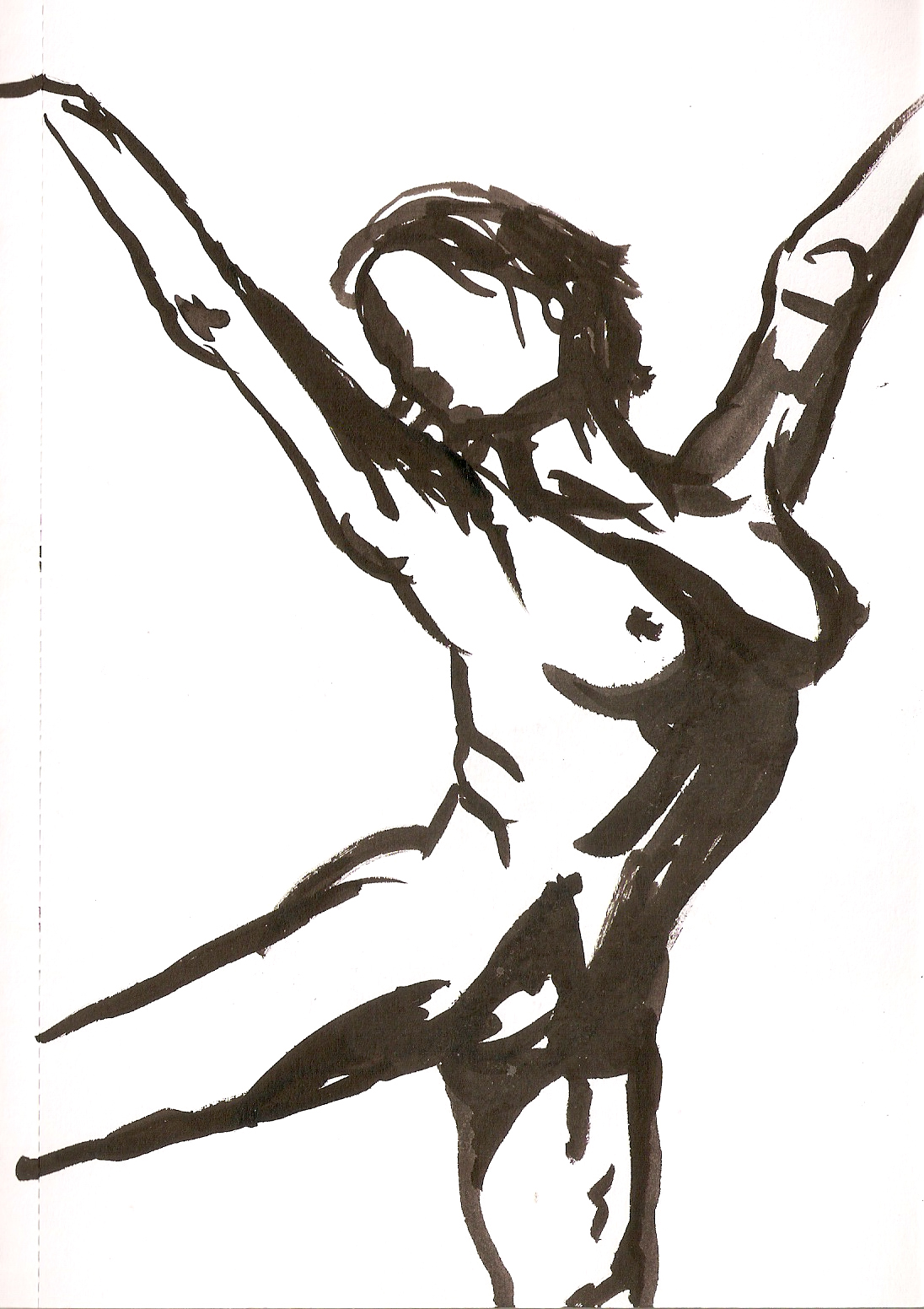
 Something that i have enjoyed studying human anatomy in the life drawing classes here, is that with each week we were challenged with experimenting with a new medium to use, and I loved it! ive always been one to try new methods of drawing, and this gave me a great excuse to do so.
 A medium in which I enjoy using a lot is Indian ink, and in the life drawing classes I was re-introduced to it and reminded how much I love it in the first place. Using a brush to create very thick and strong lines has always been one of my favourite techniques, and originates from my love of Japanese art. Im definitely going to use this practice with Indian ink to take up my brush again!


 For my self directed study time, ive focused a lot on using both Indian Ink to draw the human anatomy so I can fine tune my ability to capture the human form, and area I love studying. I think this constant observational work will help my understanding a lot when it comes to the character projects we have been set, and will be set in the future.


Character Design
As long as ive been aware characters have always been something that have stood out to me regardless of whatever medium they were in. This may sound stupid, as characters in all things appeal to someone on some level, but to me they stood above everything else, and a characters story would be what captured me from start to finish, and in turn influence me in drawing mostly ‘characters’ (whether they were of my favourites or of my own creation) for as long as ive been old enough to draw.
Books like Harry Potter and literally any Terry Pratchett novel, are some personal choices in which characters would stand out to me, both full of great examples. Movies as well, and the Star Wars saga in particular influenced me in my early childhood to have a fascination with the human character. key archetypes are seen throughout all great stories, regardless of what media they are in, and comparing two of my personal choices above; the wise old master (Yoda and Dumbledore), the hero (Luke Skywalker and Harry) and the ultimate bad guy (Darth Vader and Voldemort), and these archetypes are important. Too many characters seen in game try to be in depth by avoiding being the obvious archetype but by doing so become bland in the process and lose the character that the audience wants to connect with and empathise with in the first place, the sort that are prevalent throughout all good stories. Because that’s what a character must above all do; tell their story, and the best characters can make you believe them and stick with them from the start of their journey to the very end…. And make you genuinely sad when their story is over! Because emotions are what humans use to respond to other humans, its how we read stories and situations and how we connect to a story being depicted to us.
Although the appearance of a character is how we initially relate to them, they have got to appeal to us on a much deeper level if we are willing to accompany them on their journey and invest our time in them, as we look at their heart, their plight their nature and the reason behind them being the characters they are. I think that’s why regardless of how advanced graphics in videogames get, it doesn’t affect how much we then relate to the characters being depicted to us; its like the uncanny valley theory, where robots that have been advanced to the point where they look almost identical, but not perfectly like humans, cause people to be repulsed by them. This is because when things are pushed further and further to resemble a human, it will sooner reach a point where it becomes not human at all, and the rest of us will lose the empathy that we share with others. This shows that appearances aren’t the key thing to how we relate to a character, and the clue is in the name itself; Character, its their identity how they behave and act that will appeal to us in the long run, regardless of what media we encounter them in. it’s the characters that carry a story to its conclusion.
I think the stories that really reach out to me (and most people) are those we can relate to in some way. I personally love big epic adventures, that take you to faraway and fantastical places that spark your imagination. Its not only a form of escapism, but its all relevant to life; starting out in your early days, setting out to experience something new, unexpected things happening along the way, new friends encountered, happy and sad times experienced, and the ultimate conclusion…. All of these things reflect our life, down to the most basic comparisons and it sounds cliché (but what doesn’t nowadays?) but all good journeys reflect the journey of life, all full of those interesting characters we relate to and experiences we go through, from beginning to end.
 |
| Any solid story contains archetypal characters that we can all relate to, whether they are obvious or not. Here are some examples of the 'wise master' seen throughout various stories. |
 |
| Although older games struggled to translate the strength of their characters with their 2d sprites, the closer and closer we have gotten to perfectly replicating the human form in video games the less appealing they seem to be (in some, not all instances)... maintaining that the internal character and the power of their story shines through their appearance and design, and reaches their audience is a character designers main challenge. |
I think the stories that really reach out to me (and most people) are those we can relate to in some way. I personally love big epic adventures, that take you to faraway and fantastical places that spark your imagination. Its not only a form of escapism, but its all relevant to life; starting out in your early days, setting out to experience something new, unexpected things happening along the way, new friends encountered, happy and sad times experienced, and the ultimate conclusion…. All of these things reflect our life, down to the most basic comparisons and it sounds cliché (but what doesn’t nowadays?) but all good journeys reflect the journey of life, all full of those interesting characters we relate to and experiences we go through, from beginning to end.
Wednesday, 21 March 2012
Directing Art with Art Direction
Art direction in the game production process is easily one of the key things that is naturally responsible for how the finished product will look and feel to play. As the name suggests, Art Directors are the ones responsible for leading the way and making the key decisions on the games visual feel and style, and making sure all the elements that tie into the game work fluidly together to create a polished finished game. All of the game artists that work on a game, regardless of whether they are responsible for characters, concepts, environments or props they all answer to the Art director, as they all need to follow his vision of what he has set out for the game to ultimately be.
Though a role that allows a lot of freedom creatively, the strength of the ideas created by the Art Director is ultimately what will make a game good or bad, as well as their ability to look at the bigger picture of their vision and be able to piece all of the game elements together into one solid Idea. Everything in the game must relate to what the Art Directors vision is, because if it doesn’t (e.g. if say, a tree is created and put in the game that has a very European influence and setting, and it’s a palm tree then its going to stand out like a sore thumb and detract from the immersive qualities the game is trying to create for the players) then the illusion of a believable world is going to be shattered.
Though Art Director’s are pretty much the same throughout whatever medium they work in (games, movies, etc) they have to make their idea adapt to whatever platform and medium they are working to, so they get their vision across as clearly as possible. For example, an Art Director working on a game would have to create Art specifications for each element going into the game, such as a detailed description on characters and props, outlining not only how they act but also illustrations and references of them and information on what the budget is for modelling each thing. As much information is provided to make the transition of the Directors vision to the game artists to the final in game rendering as smooth and seamless as possible. Art Directors who work in films do very much the same, but have to take into consideration other aspects such as location, and actual props and set pieces to utilize in the filming process. Its only until recent times have the lines between the two become blurred, as production costs now rival those of movies, as they utilise the same research into location, epic set pieces and in depth character expression that only used to be seen in the movie world.
I think to become an Art Director in any creative industry, you’ve got to have the ability to take your ideas and present them as clearly as possible to others. Although a strong idea will make or break a game, if it isn’t carried all the way through the development process, through solid design documents, storyboards and visual research and influences, it can lead to what was a very strong idea being turned into a crap game.
Though a role that allows a lot of freedom creatively, the strength of the ideas created by the Art Director is ultimately what will make a game good or bad, as well as their ability to look at the bigger picture of their vision and be able to piece all of the game elements together into one solid Idea. Everything in the game must relate to what the Art Directors vision is, because if it doesn’t (e.g. if say, a tree is created and put in the game that has a very European influence and setting, and it’s a palm tree then its going to stand out like a sore thumb and detract from the immersive qualities the game is trying to create for the players) then the illusion of a believable world is going to be shattered.
 |
| Storyboarding for video games is used not only to show how events progress and happen in the game, but also how the player would manoeuvre the character about the game world itself. |
Though Art Director’s are pretty much the same throughout whatever medium they work in (games, movies, etc) they have to make their idea adapt to whatever platform and medium they are working to, so they get their vision across as clearly as possible. For example, an Art Director working on a game would have to create Art specifications for each element going into the game, such as a detailed description on characters and props, outlining not only how they act but also illustrations and references of them and information on what the budget is for modelling each thing. As much information is provided to make the transition of the Directors vision to the game artists to the final in game rendering as smooth and seamless as possible. Art Directors who work in films do very much the same, but have to take into consideration other aspects such as location, and actual props and set pieces to utilize in the filming process. Its only until recent times have the lines between the two become blurred, as production costs now rival those of movies, as they utilise the same research into location, epic set pieces and in depth character expression that only used to be seen in the movie world.
 |
| With movies, set pieces and capturing the action that needs to be translated onto the big screen seems to be the main focus, though as shown here the focus on characters and how their emotions and expressions come across, is an equally big factor. |
I think to become an Art Director in any creative industry, you’ve got to have the ability to take your ideas and present them as clearly as possible to others. Although a strong idea will make or break a game, if it isn’t carried all the way through the development process, through solid design documents, storyboards and visual research and influences, it can lead to what was a very strong idea being turned into a crap game.
Elements of Game Design
All games are based upon fundamental elements, the key things being content, background and rules; these building blocks are what set the foundation to all games, breaking up the overall game into these categories:
- Character (who, or what you play as)
- Setting (the world the game is contained within)
- Motivation (the reason to keep playing)
- Threat (The enemies and obstacles you face)
- Reward (what you get out of playing, the payoff)
- Music (sets the tone, ambience and mood)
We are aware of these things throughout all games by comparing both older and more recent titles, and by doing so we see the key features are evident in all.

A key change in factor to games today is immersion. As soon as games made the transition from 2D to 3D, the extra dimension gave people the feeling that they were actually in the game instead of just in control of a sprite they were watching on screen. With the introduction of 3d brought with it the 3rd person shooter, and even though 2D games had utilised viewing a game from the perspective of the player before, being able to move within the game world around you took it to the new level, and games such as Golden eye, Call of Duty and FEAR (amongst numerous others) gave players the chance to dive straight in, making the sense of escapism an even greater element in videogames.

Another thing that continues to be pushed further and further is interactivity in games; From the earliest examples of sonic tapping his foot when you stand him still for long periods of time to show his impatience, up to modern games where you can literally walk down a New York street and have passing pedestrians swear at you when you barge into them… ways and methods have always tried to be implemented, to allow the player the experience of immersion and to make them feel like the world they are buying into is moving and living around them as they play.
Its not just how graphically realistic and true to its real world counterpart a game is that helps in immersing the player into a world though, otherwise games such as Sonic The Hedgehog, Mario, Pokemon and Zelda wouldn’t have become so popular. With games such as these people tend to empathise with the characters and worlds more than they would with a more realistic game, such as Call Of Duty or Grand Theft Auto. I think this relates back to the point I brought up before about escapism; a large majority of gamers play games to escape the stress of the real world, and regardless of how realistic a game is, being able to do extraordinary things and disassociate themselves from real world events is what people look for. With games that are set further from the real world the easier it is to become lost in it, and with most of the games I mentioned in this category, they are so well made with all of the elements needed that they engage their audience and allow them to believe the setting and characters they are playing as, regardless of how obscure they are in design.
Saturday, 3 March 2012
Game Review ~FINAL FANTASY IX

Year: 2000
Genre: Japanese Rpg
Platform: Playstation 1, PSN
Publisher: Square
The Final Fantasy series has always been one that has divided opinion. Ever since it has arrived in the west, there have been those that dislike them for their turn-based game play and complicated storylines and those that adored them for their unique characters and epic worlds they depicted. As a fan of the series I suppose you could say it was difficult for me to pick out just one….although FF7 was the game that introduced me to the series, it wasn’t until Final Fantasy 9 that came to realise just how incredible and influential on myself they actually were.
Final Fantasy 9 follows the story of a young thief called Zidane, who is part of a gang of thieves who plan to stage an elaborate plot to kidnap the princess of the city of Alexandria. This is only the start however and things soon develop into an epic adventure that takes Zidane and his companions across the world as they slowly come to realise that the kidnap plot was part of a much bigger picture, involving the conflict between nations and ultimately the fate of the world as they know it.

The story of FF9 is very easy to get absorbed into, and this is due in part by the characters that you meet and are developed along the way. From the womanising thief in the main protagonist Zidane, the tentative mage Vivi and to the bizarre chef Quina, every character you come across in this game, regardless of whether they play a large part in the story or not, each have just that; Character. Their all so outlandishly designed, a far cry from the ultra -realistic characters seen in the series’ latest instalment, but this makes them unique and the human qualities that each one embodies is more recognisable than the 50 billion polygon creations of this generation. there are too many scenes to choose just one of, but very simple scenes involving interaction of the games characters and a simple dialogue box evoke more of a reaction out of the immersive experience of this game without actually putting that much effort into the technical side of showing it. You actually care about the fate of Vivi, the black mage who discovers the truth behind his origins and begins to doubt the reasons for him existing at all. Isn’t that something we can all relate to? The age old question of ‘Why are we here?’ is captured brilliantly in just one of this games expansive cast, and the tragic nature of his found answers is what compels you to keep playing; not only to find out about Vivi, but every other character in the game who is developed to this degree, from start to finish.

The setting for IX was also a very unique change of direction from what previous instalments were heading towards, with more futuristic and modern worlds. IX went back to its roots with a more medieval setting with its emphasis on kingdoms and overall style of the environments it depicted. Even the airships, that are a continuing theme in the series, were designed in such a way that they looked like if airships were invented in medieval times that they would look like the ones you see in this game. Even though the final fantasy games have always mixed up magic with technology in the worlds they depicted, the focus on this instalment seems to be how magic is being used to fuel technology and in so being turned into weapons for war. This reflects on how this instalment was definitely a look back to the very first games in the series and how the simplicity of those could be translated into this newer game, and still be successful as something new, whilst at the same time paying respects as a homage to the games before it that paved the way.

The gameplay of Final Fantasy IX is the same system that has been utilised in many previous instalments, with battles taking place in random encounters when you are travelling in the games Overworld map. Battles are determined by the ATB (Active Time Battle) gauge under each characters health, that when full determines that characters turn to act in the battle. Its more dynamic than the usual ‘turn-based’ style of a lot of JRPG’s, though the random and menu based system of combat will only appeal to those that love this genre and style of game, and this is probably where it will divide opinion. Although the menu based combat wont appeal to non-fans of the JRPG genre, the method of developing your character is the simplest one seen in the series in a long time, and despite the easy to get into system, its nevertheless satisfying and addictive to master, appealing to newcomers of the game without overwhelming them with baffling menus.
Final Fantasy is always going to appeal to some people more than others, but at the end of the day, if what your after in a game is a sense of adventure, a great story and world to immerse yourself into with a wonderfully varied cast of characters… then I couldn’t recommend a game more perfect than this. A great introduction into a series of games that, love them or hate them, stand the test of time and continue to go strong and spread their influence today
Cut scene's
Subscribe to:
Posts (Atom)